Wood Sourcing Tool

Where does your wood come from?

Wood is a naturally renewable, low-embodied-carbon building material. Demand for wood products supports rural communities, timber-dependent economies, and healthy forest ecosystems. As you explore this site, you’ll learn about the diverse forests that supply U.S. wood product mills and the many interconnected factors that inform sustainable wood sourcing.

U.S. forests grow ~1.5x as much wood as is harvested and lost to mortality each year (1). Private working forests, which supply more than 90% of U.S. grown forest products, grow 53% more than is harvested each year (2).

How It Works

How can I tell if wood is sustainably sourced?

The sustainability of wood depends in large part on forest management practices. Forest management in the United States is widely considered to meet the highest sustainability standards in the world. Beyond global concerns about deforestation, modern forestry in the United States is supported by a complex and overlapping system of local, regional, and national safeguards from both the public and private sectors. Together, these systems help ensure forest management practices that support clean air, clean water, and wildlife habitat.

AWC member mills report their sourcing data annually against a three-tier framework established by ASTM D7612-21 — the standard for categorizing wood procurement practices. The standard establishes three categories that provide forest management sustainability assurances:

Non-Controversial

Legal & Low-Risk Sources

Wood from areas with low risk of illegal activity, compliant with all applicable laws, including protections for soil health, water quality, and wildlife habitat. All U.S. forestry operations are subject to environmental laws such as the Clean Water Act, Endangered Species Act, and others, which are aimed at preventing environmentally damaging practices.

Illegal logging harms local communities and disrupts wildlife habitat, often including harvesting from high conservation value forests. It is a significant issue globally, especially in tropical regions and parts of Eastern Europe. Click here to learn more about the Lacey Act.

If you purchase wood from AWC member mills or other non-controversial wood, you can be sure it was harvested following a rigorous set of environmental regulations and applicable BMPs. Learn about U.S. laws for addressing illegal harvesting
Responsible

Demonstrated Responsible Sourcing Practices

Wood sourced through third-party procurement certification (such as SFI Fiber Sourcing or FSC Chain of Custody/Controlled Wood) or sourced from regions with documented BMP compliance programs.

If you purchase responsibly sourced wood, you can be sure that risk mitigation, best management practices, and sustainability safeguards were applied throughout the sourcing process. Learn about procurement certification & BMPs
Certified

Third-Party Certified Forest Management

Wood from forests managed and independently verified against forest management standards, such as the SFI Forest Management Standards and the FSC Forest Management Standard. Other forest management certifications include the American Tree Farm System (ATFS) and Programme for the Endorsement of Forest Certification (PEFC).

If you purchase wood from certified sources, you can be sure that the specific forest where the wood was harvested is verified, through independent audits, as being managed according to a forest management standard. Learn about forest certification
Harvest Sustainability

Is wood harvested at a sustainable level?

Yes! The total U.S. forest growth-to-drain ratio currently stands at about 1.5:1 for U.S. working forests, meaning working forests grow ~1.5 times as much wood annually as is harvested or lost to mortality (1). Growth-to-drain ratios are useful metrics to measure harvest sustainability because they capture the net change of wood in forests. U.S. harvests occur on less than 2% of working forests each year (3), and forest growth has been greater than harvests and tree death for decades (4).

In 2024, U.S. forests (both working and non-working) were a net carbon sink, removing approximately 855 million net tonnes of CO2 equivalent from the atmosphere. That’s equivalent to roughly 14% of total U.S. gross emissions (4). At the same time, these forests supplied nearly 14 billion cubic feet of timber (1), including for structural wood products, paper, hardwood, fuel, and other products. Together, these products provided an additional carbon sink of 101 million net tonnes of CO2 equivalent (4).

Private working forests, which account for 47% of all forests (3) supply 88% of the total U.S. harvests (5) while accounting for about half of all carbon stored in forests (3) and 72% of the total annual gross carbon sequestration (5).

1.5:1

Growth-to-drain ratio — working forests grow ~1.5 times as much wood as is harvested or lost to mortality each year.

956M

Net tonnes CO2e removed by U.S. forests and wood products in 2024.

14B ft³

Cubic feet of timber supplied annually for structural products, paper, hardwood, fuel, and other products.

What is sequestration?

Carbon sequestration occurs when trees grow, using photosynthesis to pull carbon dioxide from the atmosphere and store it in biomass. Sequestration refers only to growth, while net removals or net change accounts for growth and emissions from harvests and tree mortality.

Click here to learn more about U.S. forest carbon removals and emissions.

Timber Volume on Timberland, 1953–2022
Billion cubic feet · By region and species type
South, SW
South, HW
North, SW
North, HW
Pacific Coast, SW
Rocky Mtn, SW
Growth, Harvests & Mortality on U.S. Timberland, 1976–2022
Billion ft³/yr · Line = net change
Growth
Mortality
Harvests
What is net change?

Net change is the annual cumulative increase to the volume of wood in U.S. forests. In other words, net change is the total amount of wood grown, minus losses from harvesting and tree mortality.

Our Wood Sourcing Tool
Look up sourcing data by mill or region
or

Enter the mill grade stamp number found on your lumber to find sourcing data for that mill, or select a region to browse all data for that area.

The data presented in this tool comes from an annual survey of AWC member company mills, who represent 87.5% of structural wood products manufactured in the United States. Learn more about the data

Data from annual AWC member mill survey · Aggregated by region to protect mill confidentiality
U.S. Forests

Where does U.S. wood come from?

The U.S. is home to around 763 million acres of forests (6), and around 509 million acres of those are “working forests” that can be harvested to produce renewable and sustainable wood products (1). Annually, less than 2% of U.S. working forests experience any kind of harvests (3). About a third of U.S. forests are “non-working forests”. Non-working forests include areas protected by federal, state, and local jurisdictions, like National Parks, as well as areas that are not productive enough to harvest, such as dry or high elevation forests. Non-working forests are only harvested in rare circumstances, such as for specific forest health mitigation projects, and provide only 0.4% of annually harvested timber (5).

Working forests often create buffers of protection against wildfire and other forest threats for non-working forests, which are often not actively managed.

Click here to learn more about the differences between working and non-working forests.

Regions

Forests across the conterminous U.S. are grouped by the U.S. Forest Service Resource Planning Act (RPA) Assessment into four regions: the Pacific Coast, Rocky Mountains, North, and South (7). Explore the Wood Sourcing Tool to learn how each region supports a unique mix of tree species, forest conditions, ownership patterns, and timber production.
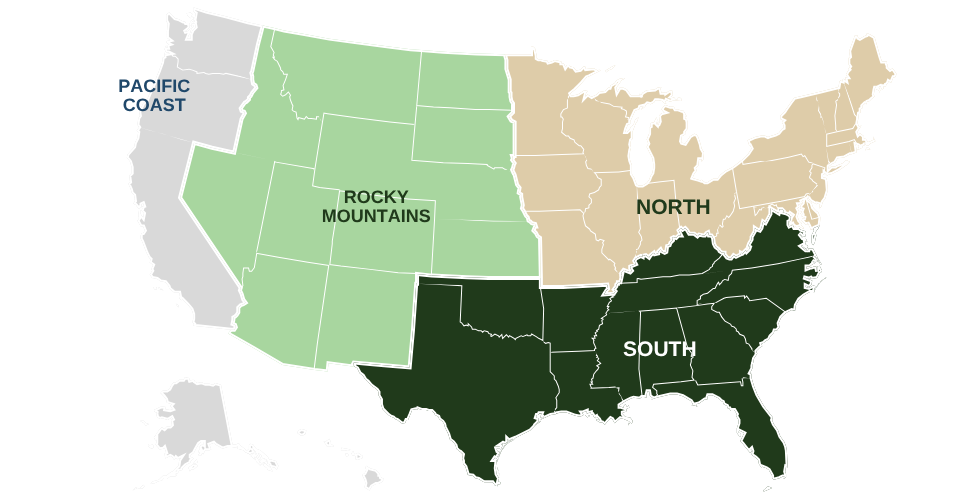
U.S. Forest Regions
Forest Regeneration

Forest Regeneration

Generally, there are two main ways that forests can be regenerated, or regrown, after harvesting: planting and natural regeneration. Both methods play an important role in maintaining the timber supply in the U.S. and protecting crucial ecosystems.

Planted Forests

Planted forests are an essential part of the U.S. timber supply, providing 43% of the harvested timber each year (5) despite only making up 9% of total forest area (6). Planted forests are most typical for commercially grown species, or to help with ecological restoration after natural disturbances like wildfires. 99% of planted forests in the U.S. are comprised of native species (6), with the two most common being loblolly/shortleaf pine in the South and Douglas-fir in the Pacific Northwest (1).

Naturally Regenerated Forests

Around 692 million acres of U.S. forests are naturally regenerated, meaning they rely on natural processes such as seed dispersal and sprouting to grow new trees (6). Over 200 species are harvested annually from naturally regenerated forests in the U.S. (5). In some forests, natural regeneration rather than planting is the most effective and ecologically sound method. Natural regeneration techniques are usually selected before harvest and tailored to specific conditions within a forest landscape.

Interplanting within Naturally Regenerated Forests

Increasingly, some working forest managers are responding to changing environmental conditions by adopting new silvicultural techniques that combine natural regeneration with targeted interplanting of specific species. As the forest matures, this reforestation method becomes indistinguishable from natural growth.

Land Ownership

Who owns U.S. forests?

Private Forests

61% of U.S. forestland (both working and non-working forests) is privately owned (1). This includes roughly 272 million acres (more than any other ownership category!) owned by nearly 10 million families and individuals, with a median holding size of just 5 acres. Non-governmental conservation and natural resource organizations own another 11 million acres of the nation’s forestland (8). Private forests are especially prominent in eastern forests, where around 79% of forests are privately owned (5).

Private forests are central to the country’s wood supply, collectively providing around 88% of U.S. harvested timber (1). Private forests also store over 33 billion tonnes of carbon (3) while producing wood and fiber for products used every day.

Public Forests

Public ownership dominates western forests, where roughly 69% of forests are publicly owned, primarily by federal agencies such as the U.S. Forest Service and Bureau of Land Management (5). It is a common misconception that the National Forest System, managed by the U.S. Forest Service, is a large supplier of wood. The National Forest System supplies only about 3% of the total annual harvest in the U.S. (5) .

Tribal Ownership

Native American Tribes own 2% (17 million acres) of forestland in the U.S. (8) Tribal forests are categorized as private forests and provide important economic support for Tribal nations and carry valuable cultural significance.

Click here to learn more about Tribal forests.

U.S. Forest Area by Land Ownership, 2022
Share of total U.S. forest area · Source: Oswalt et al. 2026
763M
total acres
Federal
25%
Family
42%
Corporate
17%
State
6%
Local
3%
Tribal
2%
Unknown
5%
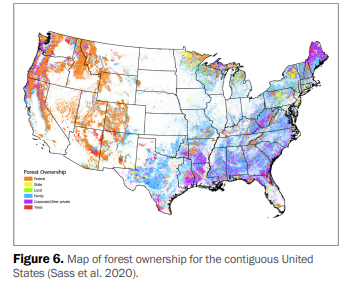
Map of Forest Ownership, Contiguous U.S.
Federal dominates the West; family and corporate ownership concentrated in the East and South
Map of forest ownership for the contiguous United States

Map of forest ownership for the contiguous United States. Source: Harris, et al. 2025 .

Land Ownership and Management Objectives

Most forests, both public and private, are managed for multiple purposes, including timber production, wildlife habitat, watershed protection, and recreation (9, 10). Forest management plans help landowners identify activities that support their objectives and ensure that these activities, including harvests, are sustainable. Management plans also help to mitigate forest threats like pests, wildfire, and invasive species. Most public and corporately owned forests operate under formal management systems and plans (11).

Family forest owners, however, often have limited time, resources, or incentive to develop plans for small tracts of land that may only be harvested once in a generation; as a result, less than a quarter of family forest acres are under a forest management plan (9). However, many of these forests may still be managed sustainably despite not being covered by a formal plan, and much of the wood from these forests qualifies as responsibly sourced fiber under ASTM D7612.

Together, these ownership types support a broad range of forest benefits, from a reliable supply of sustainable timber to ecosystem and wildlife protection, carbon storage, and recreation.

Forest Health

What are the biggest threats to U.S. forests — and how can wood products help?

Land Conversion & Deforestation

Deforestation occurs when forests are converted to other long-term, often permanent land uses. Overall, the area of forestland in the U.S. has remained stable since the early 1900s. Where deforestation does occur, it is primarily driven by conversion to urban development (12 and 7). About half of new developed lands in the U.S. over the last 40 years were converted from forest or rangeland (7).

Consistent, reliable demand for forest products helps prevent deforestation (13 and 14). Small family forest owners, who own over a third of U.S. forest area, often rely on income from harvesting and selling their wood, and without strong markets, they are often compelled to convert their land to other uses to provide the revenue stream their families rely on.

What is urban development?

Urban development includes the expansion of residential, commercial, industrial, and infrastructure uses, such as housing, buildings, roads, and other utilities.

Wildfire

Fire is a natural part of many forest ecosystems, but over the past two decades, wildfires have increased significantly in frequency and intensity. Between 2000 and 2017, wildfires increased nearly 200% when compared to earlier years (7). A changing climate is intensifying this problem, with hotter temperatures, drier conditions, and stronger winds increasing both the frequency and severity of wildfires (15).

Over a century of fire suppression and limited active management have allowed fuels to accumulate well beyond historical levels in many U.S. forests (16). When forests become overstocked with too many trees, competition for water and nutrients increases, and trees become stressed. When dead and weakened trees accumulate, they act as fuel, which drives extreme wildfires, especially in the western United States.

Active forest management, including thinning from overstocked forests, can help mitigate the risk of catastrophic wildfires while encouraging healthy forest ecosystems (17).

Click here to learn more about wildfire

Click here to learn about common misconceptions about wildfire

Drought, Pests, Disease & Invasive Species

Other major threats to forests include drought, pests, diseases, and invasive species, all of which can weaken forest health and resilience and reduce forest carbon stocks.

Drought stresses trees and makes forests more vulnerable to other threats, such as insect outbreaks, disease, and wildfire. U.S. Forest Service projections suggest that up to half of U.S. forests and rangelands could be exposed to drought by mid-century (7).

Invasive plant species compete with native plants, disrupting ecosystems and increasing tree mortality, particularly near agricultural and developed lands.

Insects and pathogens can cause widespread loss of individual tree species, and trees killed by pests and disease can also increase fuel loads in forests, making them more susceptible to wildfire (7).

Strong markets for wood products help landowners keep forests healthy by providing incentives and resources for active management, including thinning and other treatments that support long-term forest resilience.

Forest area in the United States
U.S. forest area has held steady since the early 1900s while the population has more than tripled
Forest area (million acres), left axis U.S. population (millions), right axis
Sources: forest area, Oswalt et al. 2026 (1); U.S. population, U.S. Census Bureau, 2021 (27).
Forest Management

What forest management practices are used in the U.S.?

Forest management practices vary widely for different forest types and management objectives, and include activities such as site preparation, planting, herbicide and fertilizer treatments, and harvesting. Harvesting includes a wide range of techniques for removing trees from the forest, including thinning, clearcutting, and many others. Different types of harvest help to reduce stress on the remaining trees, open up the forest floor to light, and provide efficient tree removal. The type of harvest chosen by forest managers depends on the forest management objectives. Hoover et al. (2014) provides an overview of many of the forestry practices used in different regions of the U.S. (section 6.4).

In addition, best management practices (BMPs) include activities designed to protect water, wildlife habitat, and soil quality. A state-level breakdown of BMP requirements can be found here.

Are forest management practices in the U.S. climate-smart? Read more in the FAQs.

What is thinning?

Thinning is the practice of selectively removing a portion of trees from a forest stand. It is often practiced to improve forest health and to ensure the remaining trees have a better chance to grow. Thinning improves access to sunlight, water, and nutrients for the remaining trees and reduces fuel loads that can exacerbate wildfires.

Common Questions

Frequently asked questions

Written for anyone — no forestry background required. Updated with the latest research.

What are the main causes of deforestation in the US?

Deforestation occurs when forests are converted to other land uses – think urban development, agriculture, and even solar. Overall, the area of forestland in the U.S. has remained stable since the early 1900s. Where deforestation does occur, it is primarily driven by conversion to urban development (7 and 4). Some deforestation is also driven by conversion to agriculture, though agriculture is a small driver compared to urban development (12). About half of new developed lands in the U.S. over the last 40 years were converted from forest or rangeland (7), and the 2026 US GHG Inventory estimates there were 74 million tCO2e emitted from land converted to urban development in 2024 (4).  

Globally, the causes of deforestation vary depending on the region. In contrast to the drivers of forest conversion in the U.S., according to a 2015 World Wildlife Fund’s (WWF) Living Forest Report, the most common pressures causing global deforestation and severe forest degradation outside the U.S. are: large and small-scale agriculture; unsustainable logging; mining; infrastructure projects; and increased fire incidence and intensity. A more recent report in Nature analyzed the leading causes of deforestation across 179 countries, with commodities such as cattle meat and palm oil being top drivers globally (23), largely in South America, Africa, and Southeast Asia.  

Click here to read about the relationship between industrial timber harvests and deforestation rates globally.  

How does the forest products industry avoid over-harvesting?

Forest managers in the U.S. plan for decades ahead of harvest, with future generations in mind. Roughly 2% of U.S. working forests experience a harvest each year. (3) Foresters, whether for large companies, small family landowners, or tribal forests, invest significant time and thought into developing long-term plans for intentional regeneration of harvested sites. Forest management companies often use advanced growth models based on real world measurements to help them understand how their forests will grow over time and how much they can harvest on an annual basis.  The US Forest Service also publishes a Resource Planning Assessment every ten years that reports on the status of U.S. forests and projects future forest resources to ensure harvests remain at a sustainable level.  

Currently, U.S. forests grow nearly ~1.5 times as much wood as is harvested and lost to mortality each year (22) and remove approximately 855 million net tonnes of CO2 equivalent from the atmosphere (4).   

If more wood is used in products, does the size and health of the forest decrease? Is deforestation a concern in the U.S.?

First, deforestation is defined as changing from a forest to a non-forest use. Urbanization, not the production of forest products, is the single biggest threat facing U.S. forests today. Wood in the US is harvested from working forests, which exclude protected and nonproductive lands. Readily accessible, healthy markets for timber help ensure landowners will have the means to regenerate their forest after harvest.  While it may seem counter-intuitive, forest product demand can actually lead to more forests. Demand for forest products provides revenue to landowners, incentivizing them to invest in their forests through replanting, management, and forest health treatments. Data show that global regions with the highest levels of industrial timber harvest and forest product output are also regions with the lowest rates of deforestation.  

How many seedlings are planted each year and how many trees are harvested?

The forest sector plants around 1.2 billion seedlings per year (21). Just over 500 million of these trees are harvested each year from planted forest stands (5). Another 175 million trees are lost to mortality. The members of the National Alliance of Forest Owners (NAFO), which represent the largest and most intentionally intensively managed forests for timber production calculate their three-year average of seedlings planted which was 400,039,899 in 2025.

What are growth-to-drain ratios?

Growth-to-drain ratios compare how much wood a forest grows each year after accounting for tree death and harvested wood. The U.S. growth-to-drain ratio is around 1.5:1 (1), meaning U.S. forests grow ~1.5 as much wood as is harvested and lost to mortality each year. For the past 50 years, harvest removals have remained below 2% of standing tree inventory, while net tree growth (accounting for mortality) was near 3%. Currently, the volume of annual net timber growth is more than twice the volume of annual timber removals. (1) 

As disturbances like wildfire and pest outbreaks rise, mortality is becoming an increasingly large factor in the growth-to-drain ratio, particularly in regions like the Rocky Mountains where there are high rates of insect infestations. (1) Mortality rates vary by region and typically range from 0.5% to 1% of standing inventory.  

While these ratios are certainly not the only indicators that can be used to determine forest sustainability, they are a simple way to show that, despite the U.S. being one of the world’s largest producers of wood products (24), we are still harvesting at a sustainable level. 

Learn more about growth-to-drain ratios of private forests in the U.S. 

Are forest management practices in the U.S. climate-smart?

The National Alliance of Forest Owners (NAFO) defines climate-smart forestry as “a dynamic and adaptable approach within sustainable forest management that optimizes climate adaption and mitigation outcomes” and recognizes the important role that different forest management practices have in achieving climate solutions. Forest carbon stocks can serve as a simple metric to determine if forest management practices are “climate-smart”. In the U.S., forest carbon stocks continue to increase each year, removing more carbon from the atmosphere than they emit (4). However, it’s important to note that some management activities that may cause a net loss in forest carbon across a landscape might also be “climate-smart”. A good example of this is fuel load reduction treatments that reduce the risk of catastrophic wildfires but may also reduce the carbon stocks in the forest.  

From a carbon sequestration perspective, is it better to let the existing trees remain standing or harvest and replant trees?

Both are valid ways to store carbon but only one creates wood products for buildings, which will store carbon throughout their service lives while simultaneously making room for new seedlings to grow. After a tree is harvested, a new one is regrown to continue the cycle of carbon sequestration. The United Nations Food and Agriculture Organization report, “Forestry for a Low Carbon Future,” lists six key strategies for integrating forests and wood products into climate change strategies:  

  1. Plant more trees  
  2. Increase carbon density/stocks in existing forests  
  3. Increase wood product carbon storage  
  4. Reduce deforestation and degradation  
  5. Use biomass for energy, replacing fossil fuel  
  6. Use wood products in construction materials, avoiding fossil fuel emissions in manufacturing products with higher combined emissions 

More information on forest age and carbon sequestration rates: Forest Carbon from Young vs. Old Forests  

Click here for more information on how harvest rotations contribute to sustainable forest management. 

What is clearcutting and why does the industry use it?

Clearcutting is a forest management practice in which most or all of the trees in a selected area are harvested at the same time. This approach allows for efficient wood removal and creates open conditions where sun‑loving young trees can receive the light they need to grow. Clearcutting sometimes raises public concern because recently harvested areas can resemble land cleared for development. However, unlike permanent land conversion, clearcuts are used in areas where trees are intentionally harvested and regrown as part of an ongoing forest management cycle. 

As with all harvesting methods, clearcutting relies on forestry Best Management Practices (BMPs) to protect soil health and water quality during and after harvest. All major forest certification standards allow clearcutting, though each sets specific conditions for its use to ensure environmental responsibility. When applied in the appropriate forest type, clearcutting can be just as sustainable as other management practices, provided that soil is protected and the forest is regrown after harvest. In some instances, clear-cutting can provide important habitat for wildlife. 

Learn more about clearcutting: HOW WE DO IT: Clearcutting   |   Oregon Forest Resource Institute: When is clearcutting the right choice? 

How can I find wood products that come from sustainably managed forests?

In the U.S., forestry is practiced under strict regulations that include protections for soil health, water quality, and wildlife habitat. Architects, engineers, and other design professionals can find additional assurance that timber comes from sustainably managed forests through mechanisms like certification to procurement or forest management standards.  

Here are some common labels to look for as you seek wood products that meet your project’s sustainability goals: 


Learn more: SFI On-Product Labels 


Learn more: FSC On Product Labels 


These databases can help you identify mills with fiber certified to procurement or forest management standards: SFI Certified Organizations   |   FSC Public Certificate Search   |   PEFC Find Certified. You can also connect with companies individually to learn about their sustainable sourcing practices!  

What qualifies wood as “responsibly sourced”?

Mills have invested significantly in certifications and internal supply chain verification systems. The underlying work required by those certifications and internal controls help  assure consumers their wood is not coming from practices that are harmful to forest ecosystems. Responsibly sourced wood goes beyond harvest legality by showing that risk mitigation, best management practices, and sustainability safeguards were applied throughout the sourcing process. Sources can be qualified as responsible in a couple of ways: 

The first is if the company or mill that manufactures the wood product has an independent certification to a procurement standard, such as:  

  • SFI Fiber Sourcing – requires organizations to demonstrate knowledge of the origin of their wood fiber supply and the supply chain participants involved, and to implement measures that ensure responsible sourcing. 
  • SFI Chain of Custody – requires organizations to have processes such as inventory control, employee training, reporting, and invoicing so they can track raw materials from certified sources or recycled content through production and manufacturing to the end product. 
  • FSC Chain of Custody – required for companies who want to pass on an FSC claim to customers through sales and delivery documents, apply the FSC on-product label, or process FSC certified products and materials. 
  • FSC Controlled Wood – requires that non-certified materials are controlled to reduce the risk of sourcing from places with harmful forestry practices, such as illegally harvested wood or harvests that threaten high conservation value areas.  
  • PEFC Chain of Custody – enables companies to demonstrate responsible sourcing by providing assurance that they have systems to identify, manage and trace PEFC-certified material, recycled material and material from PEFC Controlled Sources. 

To qualify for these standards, a manufacturer must have a system in place that verifies their wood is harvested in compliance with all relevant legal requirements and is coming from forests with responsible practices, including measures that protect biodiversity and ecologically and culturally important areas. Companies certified to these standards are third-party audited to ensure compliance. 

Another is if wood comes from a geographic area that has programs that implement best management practices (BMPs). BMPs are practices implemented by forest managers and loggers aimed at protecting water quality during all phases of forest management.  To qualify as ‘responsible’ under ASTM D7612, the applicable standard or forest governance in the geography must include compliance with BMPs and ensure all fiber comes from known and legal sources. To date, Oregon is the only state to officially have an approved state-based ASTM D7612 compliance program, though other states are likely eligible. 

See the additional resources section for more information on procurement certifications.

How common are sustainable procurement certifications?

Responsibly sourced wood goes beyond harvest legality by showing that risk mitigation, best management practices, and sustainability safeguards were applied throughout the sourcing process. For U.S. structural wood products, the majority of producers have at least one type of procurement certification.

  • 76% of AWC member mills have SFI Fiber Sourcing and/or FSC Controlled Wood.
  • 47% of AWC member mills have SFI and/or FSC Chain of Custody.
  • 83% of AWC member mills have at least one type of procurement certification!
AWC Member Mill Procurement Certification Stats*
SFI Fiber Sourcing SFI Chain of Custody FSC Controlled Wood FSC Chain of Custody
Lumber 82% 43% 12% 15%
EWP/Mass Timber 48% 50% 24% 28%
Panels (Plywood, OSB, etc.) 72% 27% 34% 34%

*Production Weighted Averages

What is forest certification?

Forest certification is a voluntary, third-party system used to verify that forests are managed according to established sustainability standards, often covering practices related to forest regeneration, biodiversity, water quality, endangered species, indigenous peoples’ rights, forestry research, and long-term forest health. In the U.S., the most common forest certifications are the SFI Forest Management Standard and the FSC Forest Management Standard. Both standards include requirements addressing the above practices, but they differ in implementation approaches and specific requirements within each category. Click here for a more detailed comparison of SFI and FSC standards.   

In 2026, the U.S. Green Building Council (USGBC) announced a determination recognizing wood sourced under SFI, PEFC, and FSC standards, allowing wood products certified under any of these standards to count toward LEED credits equally. 

It’s important to note that not all sustainably managed forests are certified (e.g., federal forests and small family forests). The absence of certification does not necessarily indicate unsustainable practices, but certification is a useful tool for identifying sustainably produced wood products. 

See the additional resources section for more information on forest certification. 

How many acres of forests are certified in the U.S.?

There are about 102 million acres of certified forests in the U.S., which is about 20% of total U.S. working forests. Globally, the area of certified forest makes up around 11% of global forest area, with the majority of certified area located in North American and Europe. (20) 

Why aren’t federal lands third-party certified? Does that mean they’re not sustainably managed?

Certification is mostly used by private owners who intend to sell timber from their lands and want to provide sustainability assurance to customers. It can be costly, however, and many public forests are already subject to public processes (e.g., NEPA) that call for environmental assessment and transparency. Although U.S. federal timberlands are typically not certified, this does not mean they are not being sustainably managed. In 2007, the Pinchot Institute conducted a study of five national forests and found their management practices met many of the certification requirements in terms of forest planning, protection of threatened and endangered species and others. (19). Additionally, many state-owned forests are certified to the SFI or FSC forest management standards. For example, all state-managed forests in Washington State (2.4 million acres) are certified. 

Why don’t all small family forest owners certify their timberlands?

Some small family forest owners choose to certify their lands, and others don’t. Cost, complexity, administrative burden, and the diversity of landowner objectives and values make wide-scale certification difficult for small landowners. These landowners make up roughly a third of forest ownership in the U.S. (272 million acres) (8). Even though many of these lands are not certified, wood sourced from them is subject to procurement requirements by the mills that purchase their timber. For those landowners who choose to certify their forests, the American Tree Farm System standard is designed to be implemented by smaller scale forest owners. 

What emissions are included in the quantification of carbon impact of wood products in EPDs?

Wood product EPDs include emissions from forestry activities (from stand establishment through harvest), transportation, and production emissions in the mill. GHG emissions associated with forestry activities – referred to as the A1 stage in wood product EPDs – include emissions from activities like nursery operations, site preparation, planting, fertilization, thinning and harvesting. These operations are a relatively small contributor to overall wood product embodied carbon. For example, the A1 stage of the production of softwood lumber is responsible for only about 24% of the total emissions. The transportation stage (A2) includes emissions from trucking or other transportation to bring wood from where it was harvested to the mill. 

In addition to the efficient forestry operations, the manufacturing process (the A3 stage in EPDs) has lower GHG emissions than many other industries. Unlike concrete and steel, wood products do not require extremely high temperatures to produce, and most wood product mills use residual biomass from logs to fuel their operations. Wood product manufacturing is inherently low-waste, with nearly every piece of the log being used. Manufacturers also use wood residuals to create a host of products we use in our everyday lives, including composite panels, paper, mulch, and compost used to enrich soil.  

Wood product EPDs express carbon impacts in terms of Global Warming Potential (GWP). EPDs disclose both GWP-fossil (emissions from fossil sources, such as coal, oil, and natural gas) and GWP-biogenic (CO2 emissions and removals from biological materials). GWP values for wood products manufacturing can vary depending on regional factors such as the electricity grid or wood species and moisture differences. Generally, GWP impacts for wood products are lower than for alternative materials and can lead to avoided emissions when used in place of alternative materials. Wood products also store biogenic carbon while they are in use, and wood product EPDs report the carbon storage in the products as additional information.  

More LCA data on regional forestry operations can be found here.  

Link to FACT platform 

Explore wood product EPDs 

How does the U.S. wood products industry demonstrate traceability?

Wood product manufacturers source fiber from hundreds to thousands of different landowners across the U.S., and logs from those sources are mixed and sorted based on quality and other characteristics in the mill’s log yard before processing. After wood leaves the mill, it is bought and sold as a commodity product by traders and building materials suppliers across the country and moved by plane and train (and sometimes boat!). This complex supply chain means that the industry relies upon grading stamps on the products to convey procurement requirements, and in some cases chain-of-custody systems provide information on the certification types that went into the growth and sourcing of the product.  This helps track the information that’s most important to customers while not adding the expense of tracking individual pieces of lumber or hindering competition in the marketplace between the multitude of actors involved in the supply chain.   

How do wood products support a circular economy?

Wood products are an inherently circular material because trees are a renewable resource. Sustainably managed forests provide a steady supply of fiber for wood products. In addition, mills use nearly every part of the log, turning sawdust, bark, and chips into energy, paper, and other products instead of waste. Lumber and engineered wood products have long service lives in buildings, and at the end of a product’s life, wood can often be reused, recycled into other products, or used for bioenergy rather than sent to a landfill.  

Go Deeper

Additional resources

Curated research, data tools, and further reading on sustainable wood sourcing and U.S. forest management.